
Texas Democrats filed matching adult-use legalization bills within days of winning control of the state House for the first time since 2002. The twin measures, House Bill 369 from Rep. Joe Moody and House Bill 362 from Rep. John Bucy III, would build a full licensing and taxation framework under the Department of Licensing and Regulation - a structural shift that would move Texas cannabis policy from restrictive medical access toward a commercial retail model with real tax revenue attached.
What the Texas Regulation of Cannabis Act Would Actually Do
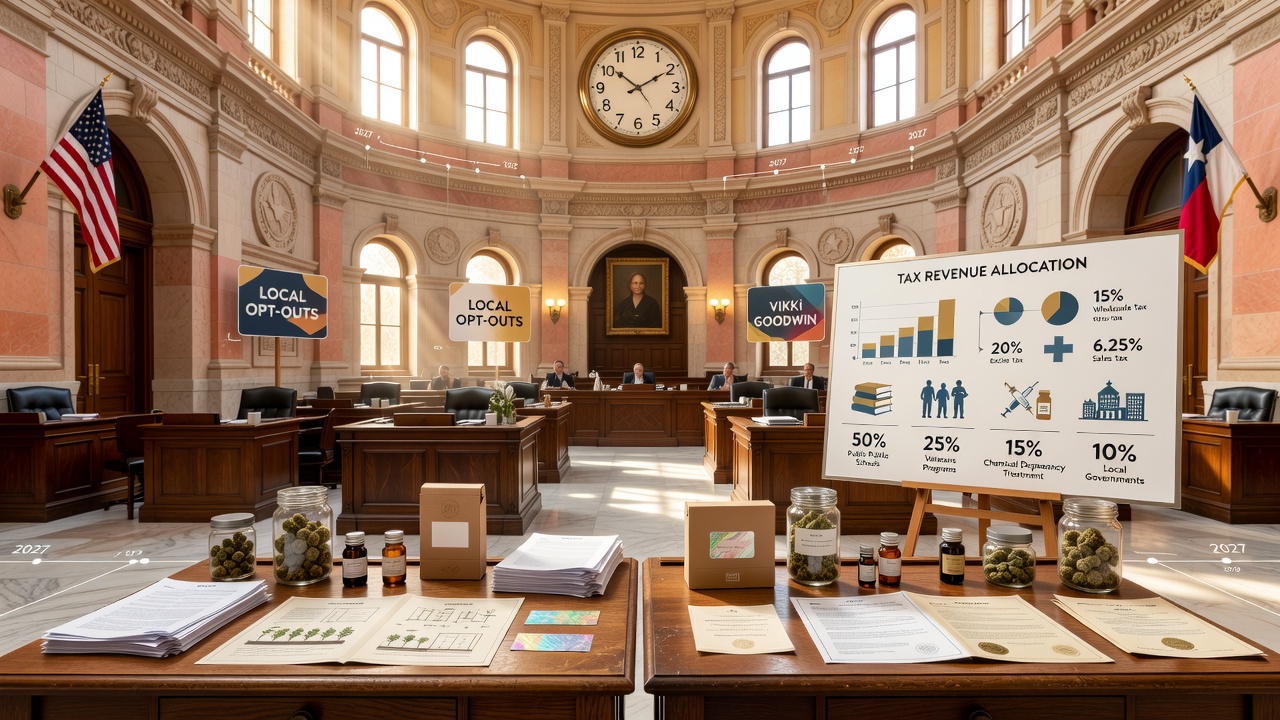
Both bills, titled the Texas Regulation of Cannabis Act, set possession limits at 2 ounces of flower or 15 grams of concentrate for adults 21 and older, with home cultivation capped at 12 plants. On the commercial side, the framework layers a 15% wholesale tax on transfers from cultivator to processor or retailer on top of a 20% excise tax at the point of dispensary sale - stacked above the state's standard 6.25% sales tax. That's a meaningful tax burden for operators to model into wholesale pricing and retail margins before a single plant touches a shelf.
The revenue allocation reads like a coalition-building exercise: half to public schools, a quarter to veterans' programs, 15% to chemical dependency treatment, and the remaining 10% to local governments for regulation and oversight. Notably, the bills would strip local jurisdictions of opt-out authority - cities and counties couldn't ban licensed cultivation, processing, or retail outright, though dispensing hours would be fixed statewide from 10 a.m. to 9 p.m. For operators used to navigating a patchwork of municipal cannabis ordinances in other states, a no-opt-out provision would be unusual, and it signals lawmakers want statewide consistency rather than a local-control fight dispensary by dispensary.
Consumer Safety Provisions Built Into the Framework
The legislation includes lab testing requirements, product labeling standards, and child-resistant packaging mandates - the baseline compliance architecture that every adult-use state has had to build before issuing the first retail license. These provisions matter beyond checkbox compliance. Certificate of analysis requirements and standardized labeling are what allow regulators, and eventually consumers, to trust that a product batch matches what's on the package. Operators planning for a potential 2027 launch would be wise to watch how these testing and packaging rules get refined in committee, since early statutory language often becomes the backbone of agency rulemaking later.
A Divided Legislature Changes the Math, Not the Outcome Yet
Here's the catch: Democrats flipped the House, but Republicans still hold a 19-12 Senate majority. No state with a divided legislature has legalized adult-use cannabis through the statehouse process - they've all gone through ballot initiatives instead. That history matters for operators and investors trying to handicap timing; a House bill with momentum doesn't guarantee a path through a Senate controlled by the opposing party.
That said, the Senate's leadership picture shifted too. Lieutenant Governor-elect Vikki Goodwin, who controls committee assignments and floor votes in that chamber, replaces outgoing Lt. Gov. Dan Patrick, whose push to restrict intoxicating hemp products drew pushback from voters. Goodwin has signaled openness to supporting hemp-industry small businesses while stopping short of committing to full adult-use legalization, noting ongoing internal debate over whether to expand the Texas Compassionate Use Program or pursue broader legalization instead. For hemp retailers and the state's existing medical cannabis operators, that distinction - expand the narrow medical program versus build an entirely new commercial market - will shape very different compliance and licensing pathways.
What This Means for Operators Watching From Outside Texas
Multi-state operators and ancillary vendors - point-of-sale providers, seed-to-sale software companies, packaging suppliers - have reason to track this closely even though 2027 is a long runway. Texas would represent one of the largest potential adult-use markets in the country if legalization ever clears both chambers. In practice, though, the near-term signal is more about regulatory direction than imminent market access. The bills establish what a licensed framework could look like: tax rates, local authority limits, testing standards, packaging rules. Whether that framework survives Senate negotiation, gets watered down, or stalls entirely is the open question that will define Texas cannabis policy through the next legislative cycle.