
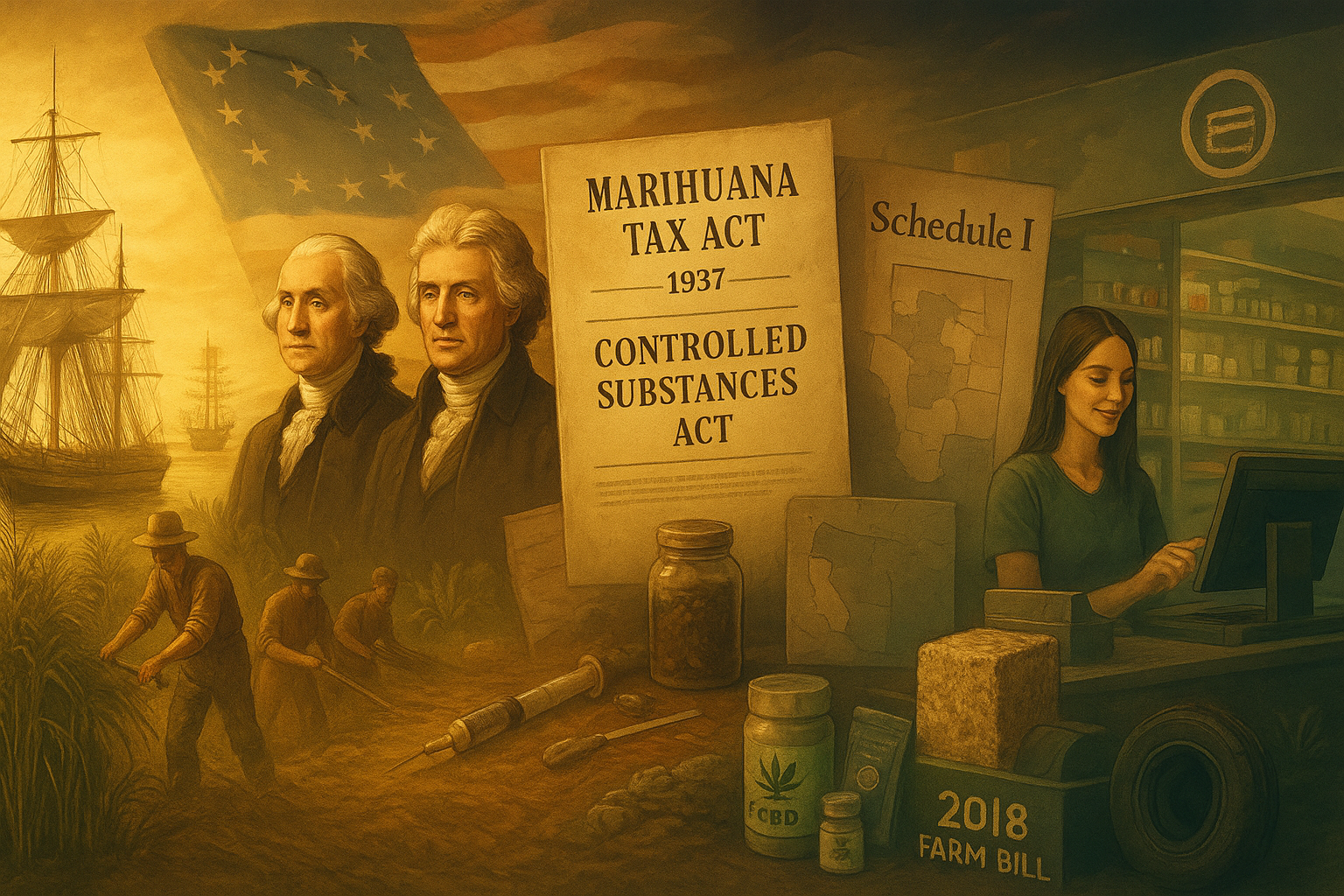
Long before cannabis became a compliance headache for dispensary operators or a line item in state budget projections, it was simply a crop - one colonial farmers grew because the economy demanded it. As the United States marks 250 years of independence, the arc of cannabis in American history offers more than nostalgia. It offers a working map of how agricultural commodities become regulated industries, how public policy lags public opinion, and how businesses are built - and sometimes destroyed - in the gap between the two.
Hemp supplied the rope, sails, and textiles that kept early American commerce moving. George Washington and Thomas Jefferson both cultivated it, though historians still debate the extent and purpose of those harvests. The point isn't romantic - it's structural. Hemp was a supply chain input before anyone used that term. It moved through farms, manufacturers, and merchants in ways that parallel how modern licensed operators manage seed-to-sale tracking, wholesale menus, and inventory documentation today. Dispensary owners running point-of-sale systems like IndicaOnline cannabis POS are, in a sense, the latest link in a chain stretching back to colonial agriculture - though the compliance logs are considerably more complicated now.
The 20th century severed that chain almost completely. The Marihuana Tax Act of 1937 and, more decisively, the Controlled Substances Act of 1970 placed marijuana in Schedule I alongside heroin - a classification declaring no accepted medical use and high abuse potential. For the industry as it exists today, that designation still carries weight. Schedule I status is the root cause of 280E, the federal tax provision that denies cannabis businesses standard business deductions. It's why multi-state operators face banking restrictions that no other legal retailer encounters. It's why cashless payment workarounds - PIN debit, ACH, and various fintech structures - became a standard feature of dispensary operations rather than an exception. The prohibition era didn't just stigmatize the plant; it built a regulatory architecture that legal operators are still working around decades later.
The Policy Shift That Changed Retail
California's 1996 medical legalization was the crack in the wall. What followed - slowly, then all at once - was a state-by-state patchwork of medical and adult-use markets, each with its own licensing structures, excise tax schedules, packaging requirements, lab testing mandates, and compliance frameworks. No federal standard. No unified seed-to-sale protocol. Just fifty different regulatory environments, many of them still evolving.
That patchwork is not an abstraction for operators. It means a multi-state operator running dispensaries in several states cannot simply replicate one store's compliance system in another jurisdiction. Inventory management, COA documentation, compliant packaging specs, advertising restrictions - all of it differs by state. The operational burden is real, and it scales. A single-location dispensary managing SKU inventory under one state's rules is a relatively contained problem. A vertically integrated company spanning cultivation, processing, and retail across multiple states faces a compliance surface area that demands sophisticated software, dedicated compliance staff, and constant regulatory monitoring.
The ongoing federal rescheduling conversation - moving marijuana from Schedule I to Schedule III under the Controlled Substances Act - would not legalize cannabis at the federal level. But it would have meaningful downstream effects. A Schedule III reclassification would remove marijuana from 280E's reach, which for many dispensary operators would represent a material improvement in effective tax rate. That's not a minor regulatory footnote. For businesses already operating on compressed margins due to state excise taxes, high real estate costs, and limited banking access, the tax burden under 280E has been one of the most concrete financial pressures in the industry.
Hemp and CBD Found Their Own Lane
The 2018 Farm Bill created a separate regulatory track. By legalizing hemp containing less than 0.3 percent delta-9 THC, Congress effectively split the cannabis plant into two policy categories. Hemp-derived CBD moved quickly into mainstream retail - oils, topicals, beverages, gummies, pet products - distributed through channels unavailable to state-licensed cannabis businesses. No seed-to-sale tracking. No license caps. No adult-use age verification at the point of sale.
That's not quite a clean win for the hemp and CBD sector, though. The FDA has yet to establish a comprehensive regulatory framework for CBD in food, beverages, and dietary supplements. Health claims remain legally constrained. The market grew fast; the rules haven't fully caught up. For brands in that space, the regulatory uncertainty creates real business risk - product lines built around positioning that regulators may eventually restrict, labeling that might require revision, and a consumer safety framework that remains incomplete.
Modern industrial hemp has meanwhile found genuine traction in manufacturing - textiles, biodegradable materials, construction applications including hempcrete, automotive components. These aren't novelty uses. They represent real supply chain diversification for farmers who needed an alternative crop with commercial demand. The agronomic story and the retail story are running on parallel tracks, and they don't always intersect the way advocates expected.
What the Next 250 Years of Cannabis Regulation Might Actually Look Like
Here's what's striking about the cannabis industry at America's 250th anniversary: it has become economically significant without resolving its most fundamental legal tension. Legal state markets support hundreds of thousands of jobs and generate substantial tax revenue for states. Licensed dispensaries operate with compliance infrastructure - age verification, inventory controls, lab-tested products, compliant packaging - that most unregulated markets never required. And yet the federal government still classifies marijuana as a controlled substance, creating the banking gaps, tax asymmetries, and interstate commerce restrictions that operators deal with daily.
The trajectory points toward eventual federal resolution. What form that takes - rescheduling, descheduling, federal legalization with regulation analogous to alcohol, or something else - remains genuinely uncertain. What's not uncertain is that the businesses built inside this regulatory gap have had to be unusually resilient. They've operated without standard banking, absorbed above-market tax burdens, and built compliance systems for a product that federal law still treats as illegal.
From colonial hemp fields to modern dispensary operations, the plant has always required those working with it to adapt to whatever the regulatory environment demands. That part, at least, hasn't changed.