
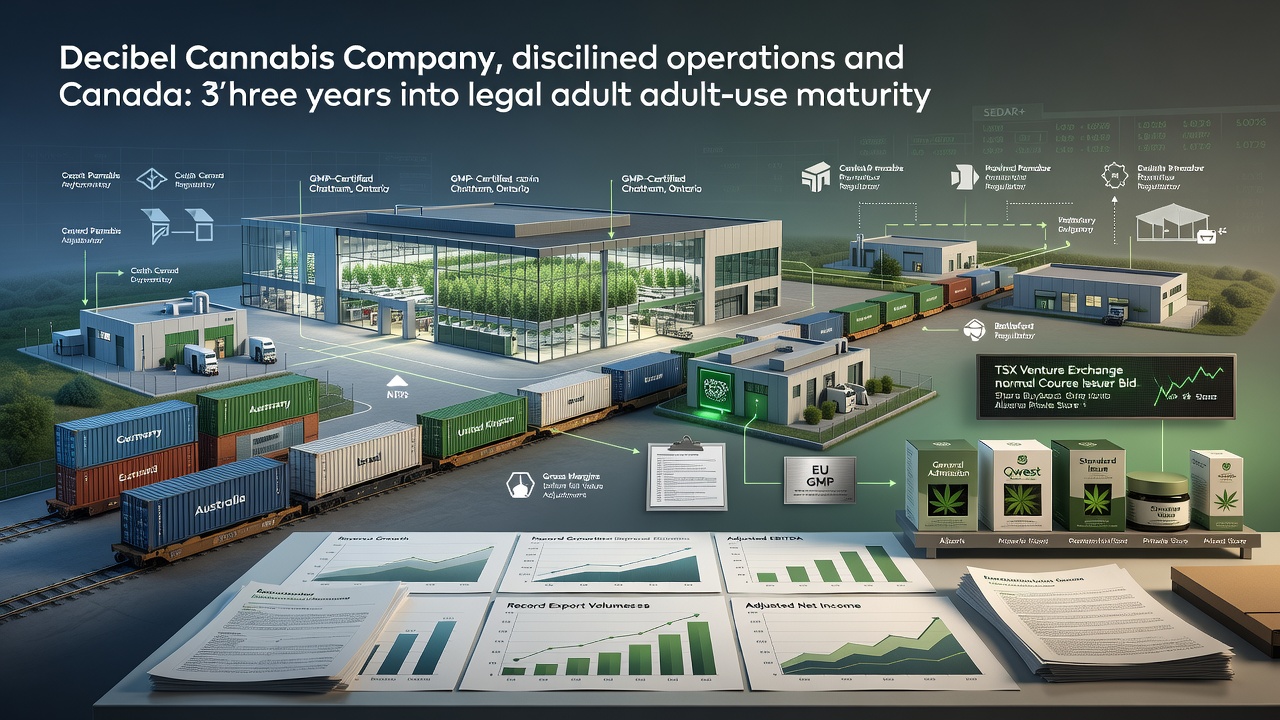
Decibel Cannabis Company (TSXV:DB) posted quarterly results that included revenue growth, improved gross margin, net income and record export volumes, then layered on reaffirmed full-year guidance and the early steps toward a normal course issuer bid. For a sector that has spent years grinding through margin compression and oversupply, a Calgary-based producer posting on multiple fronts at once is worth a closer look - not as a signal that every cannabis stock is suddenly investable, but as a case study in what a disciplined operator looks like three-plus years into legal adult-use maturity.
Reading the Margin Numbers Correctly
Gross margin before fair value adjustments is the figure that actually matters for operational assessment. International accounting standards require licensed producers to mark biological assets - growing plants - to fair value, which can swing reported profitability in ways that have nothing to do with how efficiently a facility is running. Decibel's practice of breaking out the pre-adjustment figure, alongside adjusted EBITDA and adjusted net income, gives shareholders a cleaner view of production economics. The catch is that these are non-IFRS measures, meaning companies define them on their own terms. Reconciliations in the filings matter here; without them, adjusted figures are just marketing dressed up as accounting.
Exports Are Doing the Heavy Lifting
Record exports is the phrase that deserves the most scrutiny in this release. Canadian licensed producers selling into Germany, Australia, Israel and the United Kingdom are operating in regulated medical channels that require Health Canada export permits for every shipment plus import authorization from the destination country. That is not a light compliance lift. It also means a producer's export volume is gated by two regulatory bodies, not one, and any friction on either side can delay a shipment that was already built into quarterly guidance.
EU Good Manufacturing Practice certification is the credential that makes this business possible at all. Decibel's Chatham, Ontario facility holds that certification, which is why a flower-launch agreement with Hilltop Leaf for the UK market is operationally plausible rather than aspirational. Facilities in Calgary and Battleford round out the domestic production footprint, while Chatham functions as the international gateway. That's a meaningful structural detail for anyone evaluating whether export revenue is durable or a one-quarter anomaly.
What a Buyback Signals - and What It Doesn't
Beginning the steps toward a normal course issuer bid on the TSX Venture Exchange requires exchange acceptance and comes with caps on how many shares can be repurchased. Shares bought back are typically cancelled, reducing shares outstanding and, in theory, supporting per-share metrics. In practice, though, an NCIB is a capital-allocation signal more than a guarantee of share price support - it tells shareholders management believes the stock is undervalued relative to cash generation, not that the company intends to prop up the price indefinitely. For a sector where equity has been a scarce and expensive resource, a company choosing buybacks over dilutive financing is itself a data point worth weighing.
The Provincial Wholesale Reality
None of this happens outside Canada's regulatory architecture. The federal Cannabis Act sets the framework, but provinces control distribution and retail. In Alberta, Decibel's home market, wholesale distribution runs through the provincial regulator while retail stores operate privately - a structure that shapes how a multi-brand portfolio like General Admission, Qwest and Standard Issue actually reaches store shelves. Federal excise duty is deducted before producers report net revenue, which is the basis for the figures in this release. A multi-brand strategy lets a producer target different price points and consumer segments across those provincial wholesale menus, but it also multiplies SKU management complexity and compliance overhead across every jurisdiction a brand enters.
For readers tracking TSX-listed cannabis names, the underlying lesson is less about one company's quarter and more about what sustainable differentiation looks like in this market: export infrastructure, GMP certification, disciplined non-IFRS reporting and capital allocation that doesn't rely on constant share issuance. Shareholders looking for the full picture should still turn to the interim financial statements and management's discussion and analysis filed on SEDAR+ rather than the headline figures alone.