
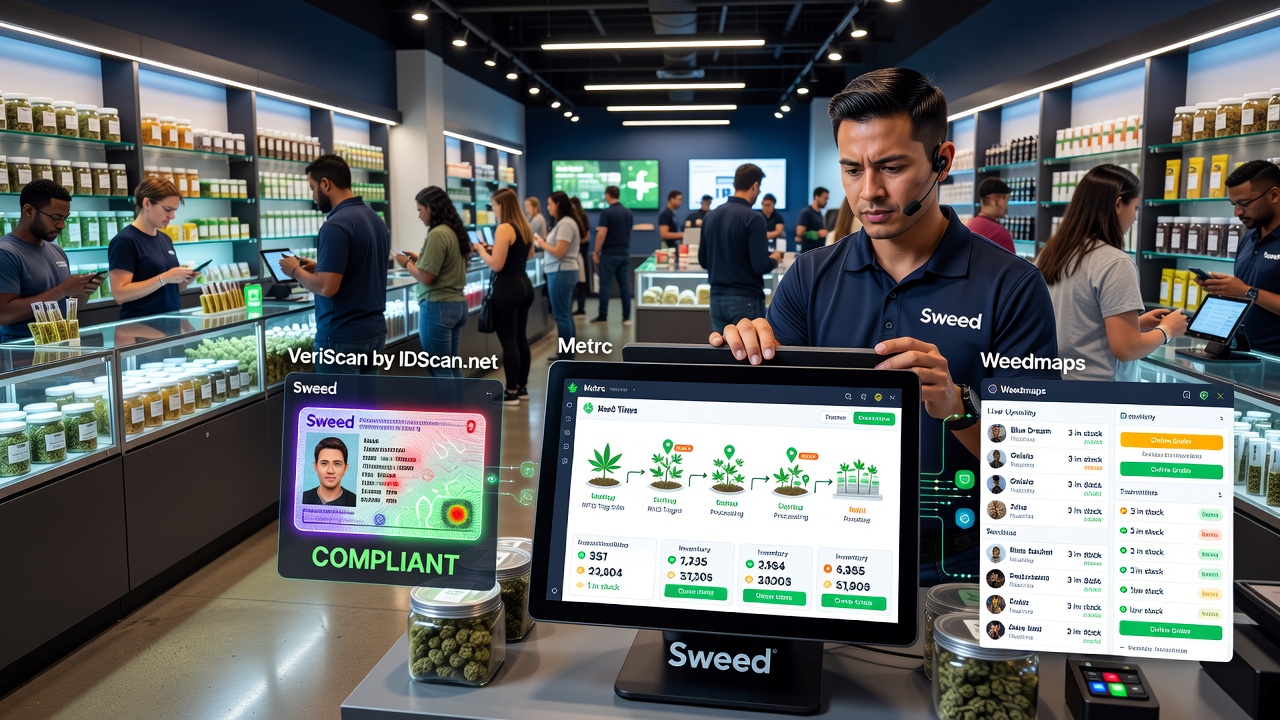
Point-of-sale providers in cannabis retail are increasingly judged not by what they do alone, but by what they connect to. Sweed, a POS and e-commerce platform built for licensed cannabis operators, has expanded its integration roster to include age verification tools, state-mandated seed-to-sale tracking, and consumer-facing discovery platforms. For dispensary owners evaluating their tech stack heading into 2026, that list matters as much as the core software itself.
Why Integrations Have Become the Real Buying Decision
Here's the catch with cannabis retail technology: no single platform handles compliance, payments, inventory, and customer verification end to end. Operators end up stitching together a POS system, a state traceability feed, an ID scanner, and a marketing or menu listing service - and if those pieces don't talk to each other cleanly, staff end up re-entering data by hand at the register. That's where shrinkage creeps in, where compliance logs go stale, and where audits turn painful. A POS vendor's integration list is, in practice, a proxy for how much manual work a budtender will face on a Friday night rush.
Age Verification Meets the Point of Sale
VeriScan, built by IDScan.net, plugs ID scanning and fake-ID detection directly into the transaction flow. The software reads driver's licenses and passports, checks them against ultraviolet, infrared, watermark, and hologram markers, and flags IDs that don't hold up. For a dispensary, that's not a convenience feature - it's a legal requirement dressed up as software. Every state with legal cannabis sales mandates age verification at the point of purchase, and a scanner that logs visits, flags banned customers, and builds a visitor profile gives an operator a defensible compliance trail if a regulator ever asks for one. Unlimited scanning without a per-ID fee also matters for high-traffic stores, where per-transaction software costs can quietly eat into margin over a full year.
Traceability Still Runs Through Metrc
Metrc remains the backbone of statewide track-and-trace in most legal markets, using RFID tags and cloud reporting to follow cannabis from cultivation through manufacturing to the retail shelf. A POS integration with Metrc isn't optional in states where it's the mandated system - it's how a dispensary proves a product batch moved legally, how recalls get traced to source, and how law enforcement and regulators verify that inventory on the shelf matches inventory on the books. When a POS platform syncs with Metrc automatically, it cuts down the double-entry errors that trigger compliance flags. When it doesn't, store managers end up reconciling manifests by hand, which is slow and invites mistakes that regulators notice.
Consumer Discovery Platforms and the Wholesale-to-Retail Bridge
Weedmaps occupies a different role in the stack - less about compliance, more about commerce. Its platform lists retailers and brands, surfaces product information to consumers, and increasingly offers ordering and logistics tools that connect back to a dispensary's live menu. A POS integration here means inventory counts and pricing update automatically across listing platforms, so a customer doesn't see a product online that sold out an hour ago. For multi-state operators managing dozens of SKUs across several locations, that kind of sync reduces customer complaints and keeps wholesale and retail pricing consistent across channels.
What Operators Should Weigh Before Committing
- Whether the integration is native or requires a third-party middleware layer that adds cost and failure points
- How the platform handles compliant packaging and labeling data alongside traceability requirements
- Whether age verification logs are retained in a format regulators can audit on request
- How pricing and inventory sync speed affects customer experience across online and in-store channels
- Whether the vendor supports the specific state traceability system in use, since requirements vary by jurisdiction
None of this guarantees a smoother operation on its own. Software only closes the gap between compliance and convenience if staff are trained to use it and if the integrations stay current as state rules shift. Still, for operators sizing up Sweed against competing platforms, the depth and reliability of its integration list is a reasonable proxy for how much friction - regulatory and operational - a dispensary will face day to day.