
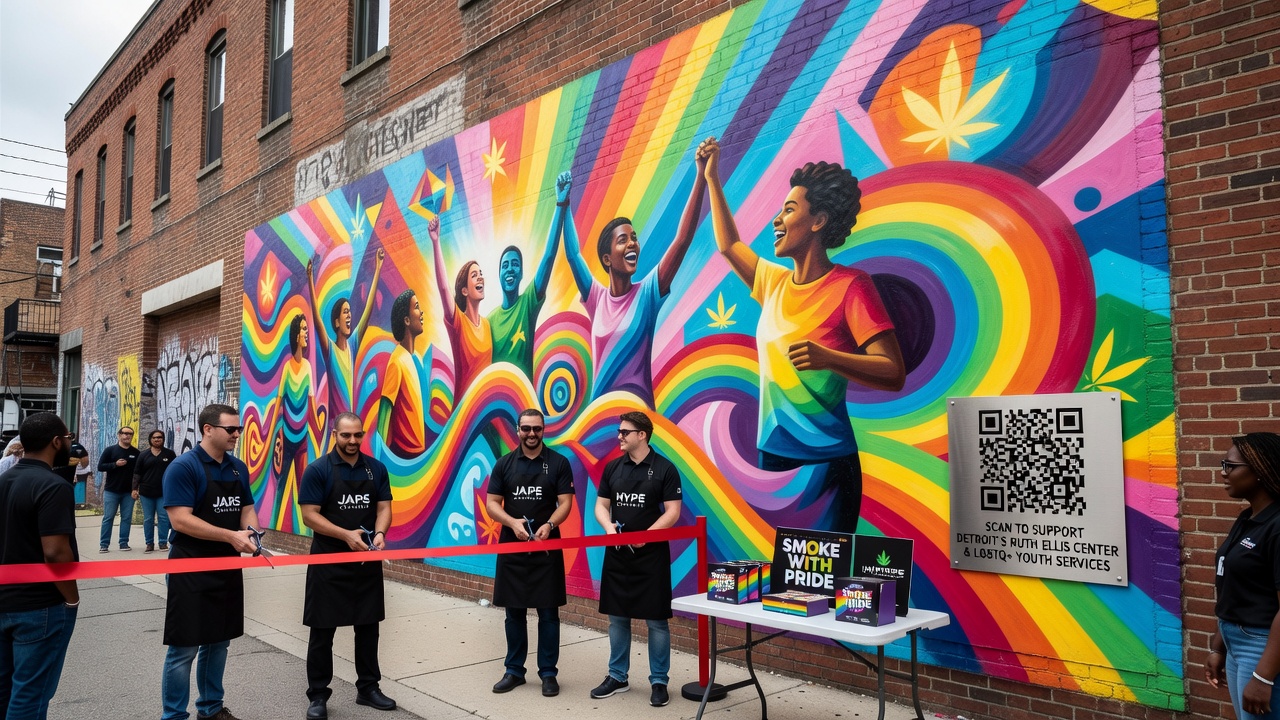
Two Michigan cannabis retailers put their marketing dollars toward a public art project this week, and the mural now anchors a broader cause-marketing campaign rather than standing as a one-off brand activation. JARS Cannabis and HYPE Cannabis held a ribbon-cutting for "Polychromatic Super You," a 40-by-25-foot mural by Michigan artist Joey Salamon, located in an alley off downtown Ferndale's Nine Mile Road corridor. The unveiling doubles as the visible face of the companies' Smoke with Pride campaign, which channels retail proceeds toward Detroit's Ruth Ellis Center, a support services organization for at-risk LGBTQ+ youth.
The mechanics of the campaign are worth unpacking, because they reveal how licensed cannabis brands are experimenting with philanthropic tie-ins under regulatory constraints that limit traditional advertising. Ten percent of proceeds from HYPE products sold at JARS locations, plus all proceeds from a co-branded Smoke with Pride kit, go to the Ruth Ellis Center. That structure lets both companies fold charitable giving into everyday point-of-sale transactions rather than running a separate fundraising apparatus - a model other operators in adult-use markets have used to build community goodwill while sidestepping the marketing restrictions that still shadow cannabis advertising in most states. For operators outside Michigan watching this play out, the back-end lift matters just as much as the front-end story: tracking a percentage-of-sale donation accurately requires clean SKU-level reporting through the store's point-of-sale system, the same infrastructure retailers rely on for excise tax remittance and seed-to-sale compliance. Retailers evaluating that kind of granular reporting capability, including operators outside Michigan researching options like a dispensary pos system vermont, are effectively asking the same question JARS and HYPE had to answer internally: can the system isolate a specific campaign's sales and donations without manual reconciliation at month's end. dispensary pos system vermont
Public Art as Compliant Marketing
Murals occupy a useful gray zone for cannabis brands. Because the artwork itself carries no product imagery, potency claims, or purchase prompts, it sidesteps the advertising restrictions that govern signage, packaging, and promotional material in most adult-use states. That's precisely why cause-driven murals have become a recurring tool for operators looking to build brand visibility in dense retail corridors like Ferndale's, where storefront advertising rules and local zoning codes can be restrictive. The QR code attached to the mural - linking visitors to campaign information and a direct donation portal for the Ruth Ellis Center - is a fairly deliberate compliance workaround, too: it moves any transactional or promotional detail off the physical artwork and onto a channel the retailer controls and can update independently of local sign ordinances.
What This Signals for Retail Operators
The broader lesson for dispensary owners and brand partners isn't about the art. It's about structuring a giving campaign so the accounting holds up. A donation tied to a percentage of proceeds needs auditable sales data, and that means compliance teams and finance staff have to agree in advance on how "HYPE products purchased at a JARS location" gets defined, tracked, and reported - especially given the reporting burdens already imposed by 280E and state seed-to-sale systems like METRC. Get that wrong, and a well-intentioned campaign turns into a bookkeeping headache. Get it right, and it becomes a template other multi-state operators can borrow when they want community investment to read as authentic rather than performative.