
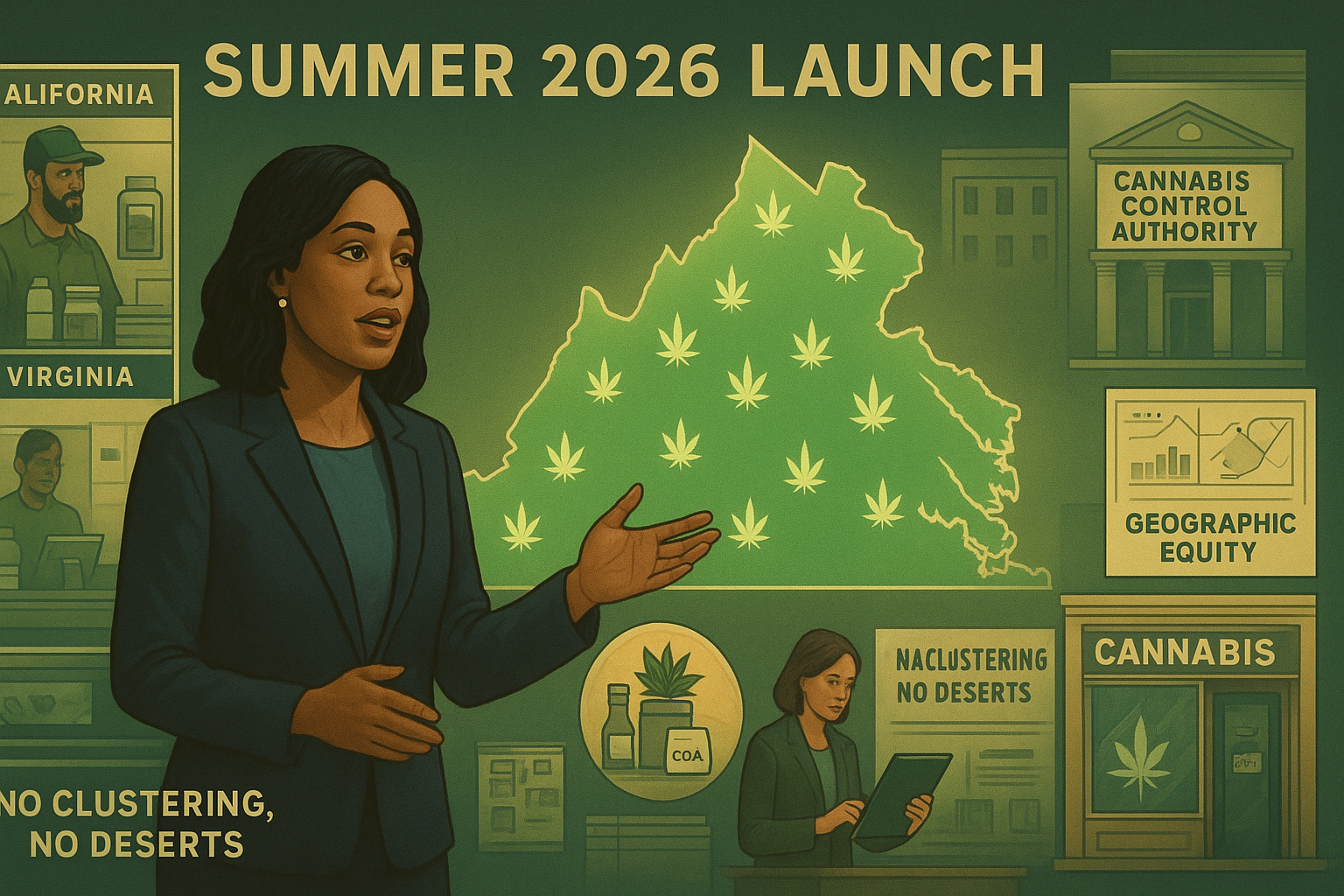
Virginia is on track to have licensed recreational cannabis retailers open for business as early as next summer, with more than 300 adult-use retail licenses set to be awarded under a regulatory framework introduced by Senator Lashrecse Aird (D-Petersburg). The Cannabis Control Authority will oversee the licensing process, with explicit authority to shape where those stores land - and where they don't. For operators, investors, and compliance professionals watching from the sidelines, the structure of this rollout carries real lessons about what a managed adult-use launch looks like in practice.
Distribution Controls: Preventing Clustering and Deserts
The legislation builds geographic equity directly into the licensing process - a design choice that separates Virginia's approach from earlier adult-use rollouts in other states. The Cannabis Control Authority is required to account for license proximity when making its decisions, and to report that analysis back to the General Assembly. Operators who have watched state markets mature elsewhere - Massachusetts, Illinois, New York - know how critical retail distribution patterns are to long-term market health. Retail technology vendors that have built compliance tools for multi-state operators understand this pressure acutely; their platform deployments in states like Massachusetts surfaced exactly how geography and licensing density shape dispensary economics at the store level. Clustering undercuts unit economics for everyone. It drives price compression, increases competition for the same consumer base, and can destabilize smaller operators who can't absorb margin pressure the way a multi-location chain can.
On the other side of that equation sits the cannabis desert problem. When local governments use zoning authority to block all applications - a tool available to them in Virginia as it is in most adult-use states - the result is not abstinence. It's a market shift toward unlicensed operators. Ngiste Abebe, vice chairman of the Cannabis Public Health Advisory Council, pointed directly to California as the cautionary case: a state where local opt-out authority has left more than half the state without legal dispensary access, and where unregulated, untaxed operators have filled that gap. That's not just a tax revenue problem. It's a consumer safety failure - products sold outside the licensed market carry no testing requirements, no COA documentation, no compliant packaging, and no age verification at point of sale.
License Caps and the Anti-Monopoly Design
Virginia's legislation caps individual business licenses at five per operator. That's a deliberate structural choice - one designed to prevent vertically integrated multi-state operators or well-capitalized investment groups from concentrating market share before smaller and social equity applicants can get established. In practice, a five-license cap does limit the economies of scale that larger operators depend on: centralized inventory management, shared POS infrastructure, bulk wholesale purchasing, and consolidated compliance reporting all become harder to amortize across a small footprint. That creates real opportunity, though, for mid-market operators and local entrepreneurs who can build competitive store-level operations without going head-to-head with an MSO running thirty locations.
The cap also shapes the wholesale and supply side of the market. Brands, cultivators, and processors entering Virginia should expect a fragmented retail environment - more accounts to manage, more individual buyer relationships, and more variation in store-level SKU preferences and inventory turnover. Wholesale pricing strategies that work in consolidated markets may need recalibration here.
What Operators Should Be Preparing For Now
A summer 2026 target sounds distant. It isn't. Licensing timelines in adult-use markets routinely compress faster than anticipated once the regulatory machinery starts moving, and operators who wait for final rules before building their compliance infrastructure tend to find themselves behind. The practical checklist is familiar to anyone who has opened a licensed retail location in a regulated state: real estate due diligence that accounts for zoning restrictions and proximity rules, POS system selection and configuration, seed-to-sale tracking integration - likely METRC, which Virginia already uses for its existing medical cannabis program - compliant packaging and labeling workflows, and staff training protocols that cover age verification, purchase limits, and responsible retailing obligations.
Virginia's adult-use market won't be simple to enter. The licensing process will be competitive, the geographic distribution rules will create uncertainty around which markets are viable, and the five-license cap means operators need to choose their locations carefully from the start. But the regulatory structure is, at least on paper, designed to produce a market that works - not just for the first wave of well-funded entrants, but for a broader set of licensed businesses and, ultimately, for consumers who deserve access to tested, legal product. Whether the execution matches the design is the question Virginia's Cannabis Control Authority will have to answer over the next twelve months.