
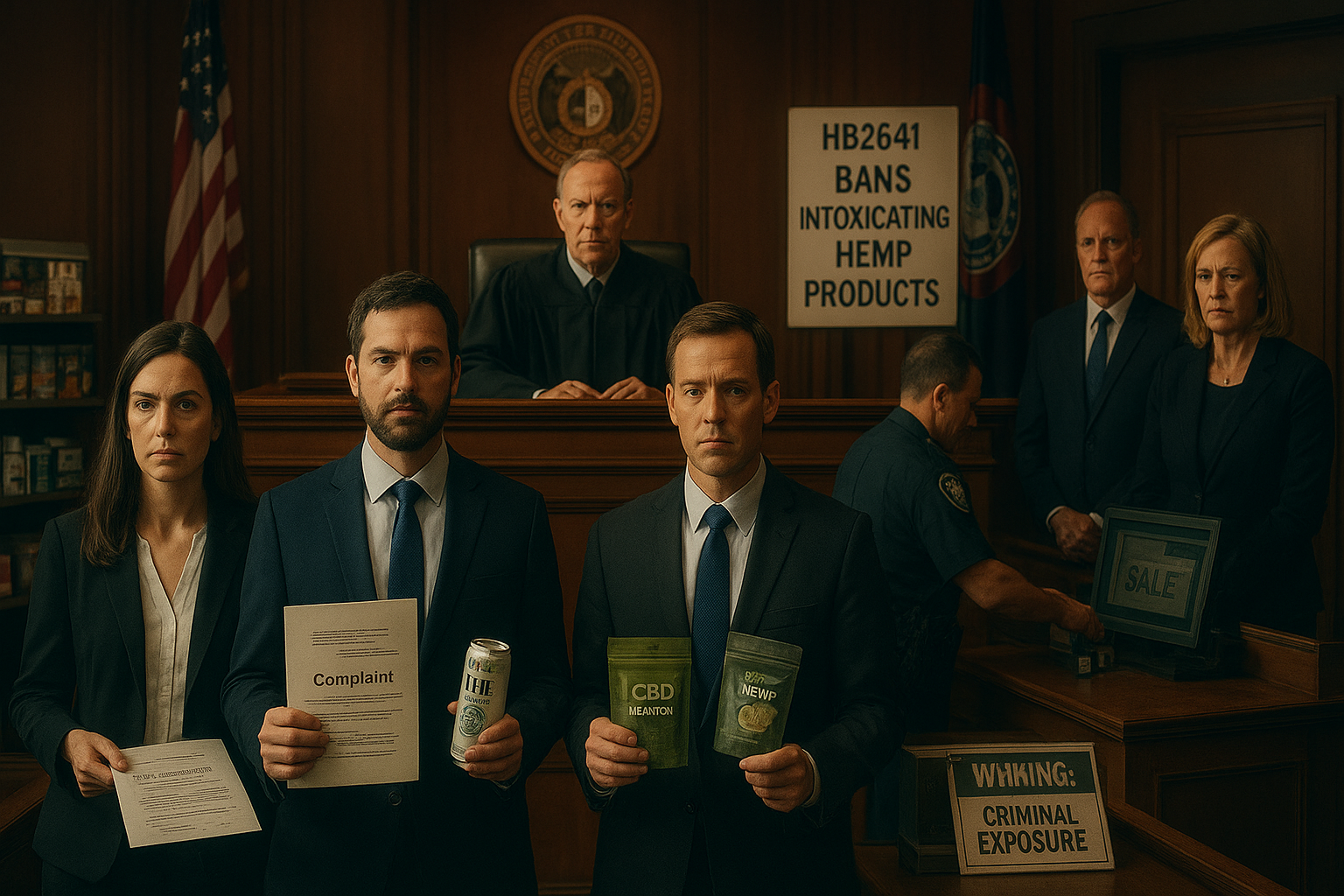
A coalition of Missouri hemp businesses filed a federal lawsuit Thursday challenging a new state law that would remove all intoxicating hemp products from retail shelves starting November 12. Filed in the U.S. District Court for the Western District, the suit argues that Missouri's HB2641 contains definitions so internally contradictory that businesses, law enforcement, and prosecutors cannot determine what is actually legal - and that the confusion carries criminal exposure for operators who stay open.
The stakes here extend well beyond Missouri's borders. States across the country have been wrestling with how to regulate intoxicating hemp derivatives - particularly delta-8 and delta-9 THC products sold outside licensed dispensary channels - since the 2018 Farm Bill opened a regulatory gap that Congress has since moved to close. Retailers and compliance officers in markets from the Midwest to the East Coast have been watching this legislative cycle closely. Even in states with mature adult-use programs, the proliferation of hemp-derived THC products through unlicensed grocery stores, smoke shops, and bars has complicated enforcement and inventory management for licensed operators. For operators tracking point-of-sale compliance across multiple states - the way cannabis pos new jersey platforms handle SKU-level product categorization and regulatory reporting - the legal ambiguity around hemp versus marijuana definitions is not a theoretical problem. It directly affects what can sit on a shelf and what gets flagged in a compliance audit.
The coalition behind the lawsuit includes MNG 2005, Inc. - the St. Louis-based parent company of 55 CBD Kratom retail locations nationwide - the Missouri Hemp Trade Association, and Wisconsin-based Lifted Liquids Inc. Craig Katz, government relations and compliance manager at MNG, put the drafting problem plainly: when legislators don't understand the technical distinctions inside cannabis chemistry and supply chain classification, the resulting statute reflects that gap. HB2641, he argued, is a case study in exactly that. The bill defines the same products as both "hemp" and "marijuana" in different provisions. That's not a minor drafting error. Because unlicensed marijuana activity is a criminal offense under Missouri law, a business selling a product classified as hemp under one section of the statute could simultaneously be in violation of the marijuana provisions in another.
What the Law Actually Does - and Where It Gets Complicated
Missouri Gov. Mike Kehoe signed HB2641 among his first acts this year. The law aligns Missouri with the federal hemp ban Congress approved last year, but it goes further in one important respect: even if Congress reverses course and permits intoxicating hemp products federally, Missouri would only allow them inside licensed marijuana dispensaries. That's a significant market restructuring. Products currently sold in grocery stores, bars, and smoke shops - THC seltzers included - would be funneled exclusively into the state's licensed cannabis retail system.
The bill's sponsor, Rep. Dave Hinman (R-O'Fallon), framed the lawsuit as a last-ditch industry effort and expressed confidence the legislation would hold. He's not wrong that the bill cleared the full Missouri legislative process. But clearing a chamber vote and surviving a constitutional challenge in federal court are different tests. The coalition's argument isn't that Missouri can't regulate hemp - it's that this particular statute is too vague to be enforced fairly, and that vagueness in a criminal context fails a basic constitutional standard.
There's also an interstate commerce dimension. The lawsuit argues that while HB2641 nominally protects interstate hemp transport through Missouri, it simultaneously restricts who may transport hemp products across state lines - a tension that touches federal commerce clause doctrine. And the bill's effective date provisions, the coalition says, are so layered and conditional that businesses cannot determine which products are covered, or precisely when.
The Licensed Dispensary Angle Operators Shouldn't Ignore
For licensed cannabis dispensary operators, the surface-level read here is straightforward: a law that pushes intoxicating hemp products into dispensaries looks like a competitive win. And fair enough - in theory, consolidating THC product sales inside licensed retail channels levels the playing field between regulated operators and unlicensed smoke shops that have been moving high-potency hemp products with limited oversight. Under the current Missouri framework, products with as much as 1,000 mg of THC have reportedly been sold in unlicensed settings, well outside the testing, labeling, and packaging requirements that licensed dispensaries must meet.
In practice, though, the legal uncertainty created by vague statutory definitions creates operational risk for everyone - including dispensaries. If enforcement agencies and prosecutors can't agree on what counts as hemp versus marijuana under this statute, compliance officers at licensed retailers have no reliable framework for making purchasing decisions, building wholesale menus, or managing SKU-level inventory against regulatory requirements. That ambiguity doesn't resolve just because a business holds a marijuana license.
Missouri Attorney General Catherine Hanaway has been tasked with enforcement under the bill. Her office said it had not yet been served the lawsuit. The named defendants - Hanaway, Gov. Kehoe, and Sarah Wilson, director of the Missouri Department of Health and Senior Services - declined to comment on pending litigation.
The Broader Regulatory Pattern Worth Watching
Missouri is not an isolated case. Similar legislation has moved through multiple state houses since 2023, as regulators try to close the hemp-derived THC loophole without disrupting non-intoxicating CBD commerce. The Missouri Hemp Trade Association's president, Jay Patel, put the industry's objection directly: this isn't consumer protection, he argued - it's the elimination of a legal market combined with a government-mandated distribution monopoly through licensed dispensaries.
That framing will resonate with some operators and irritate others. But the compliance question cuts through the politics. If HB2641 takes effect as written in November and survives judicial review, Missouri businesses selling any hemp-derived product with a THC profile will need to treat their entire product catalog as potentially subject to criminal enforcement - not just regulatory penalty. That's a materially different compliance posture than most hemp retailers have operated under, and it demands legal review of every SKU on the shelf before the effective date arrives.
The court's decision on whether to grant a preliminary injunction will be the near-term signal to watch. If the coalition secures a stay before November 12, the status quo holds while the constitutional arguments play out. If it doesn't, businesses face a binary choice: comply immediately or operate in territory where the legal exposure is, by the plaintiffs' own argument, undefined.